U.S. educational guide. Information current as of September 8, 2026.
Saving and investing are not competing teams. The useful question is: when will you need this money, and could you still meet the goal if its value fell before then?
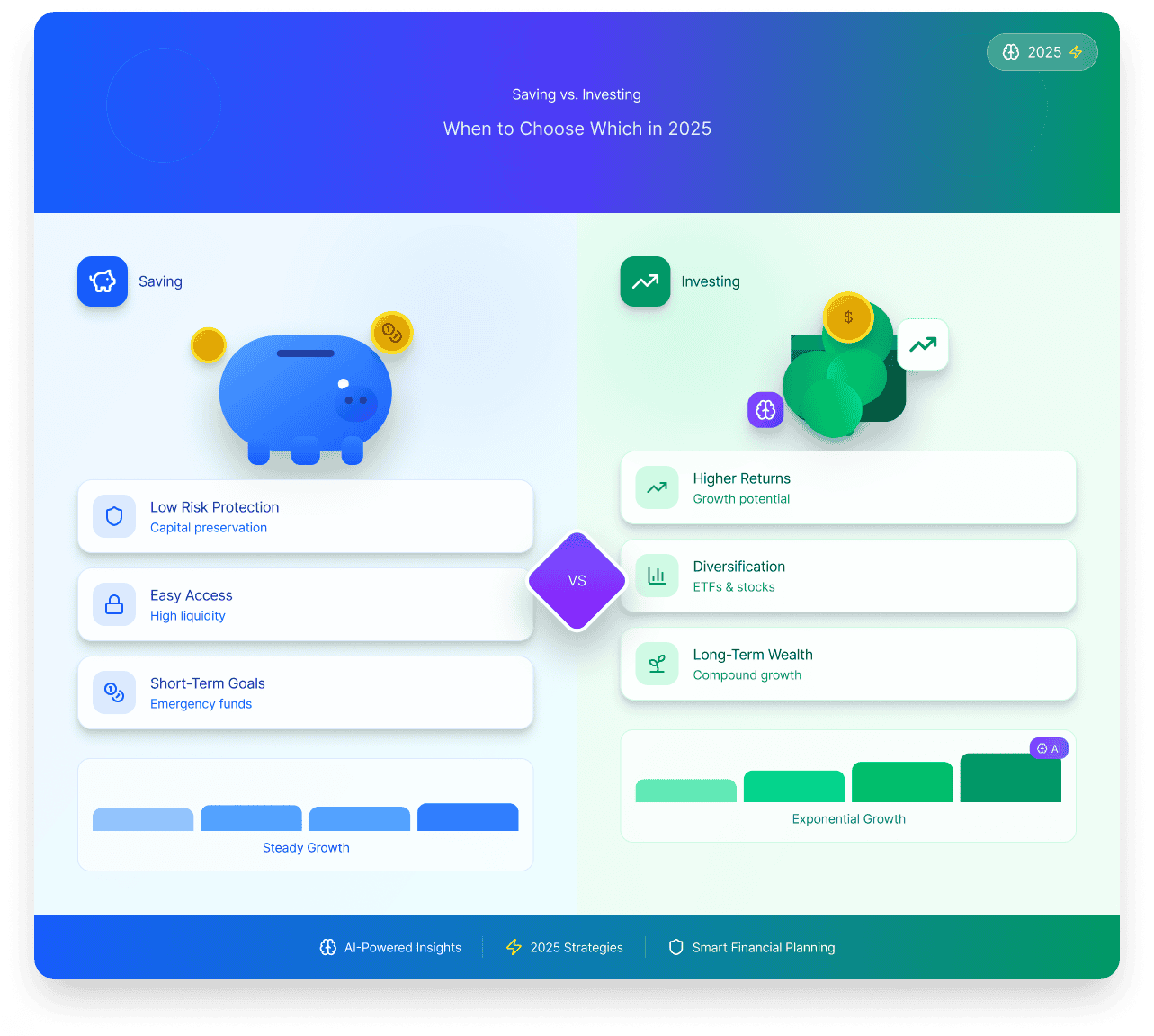
Saving generally emphasizes keeping money available for a near-term goal or an emergency. Investing means putting money into assets such as stocks or bonds in the expectation of a return over time; all investments involve risk and their value can fall. Investor.gov explains the distinction and the risk of investing.
For a goal due in five years or less, Investor.gov cautions against risky investments because you may have to sell at a loss when the money is needed. That is a useful starting point, not a substitute for considering the exact date, whether you could delay the goal, and how much loss you could absorb. Investor.gov: Gauge Your Risk Tolerance.
This is general education, not individualized investment, tax, legal, or financial advice. It does not recommend a product, security, account, or allocation. If a decision depends on your taxes, debt terms, benefits, dependents, or an investment professional’s recommendation, consider a qualified professional who is appropriately registered for the service offered.
The short answer
Choose the saving side of the decision when preserving access and the amount available for a known near-term need matters more than accepting market fluctuations. A dedicated emergency reserve is one example: the CFPB defines it as a cash reserve for unplanned expenses or financial emergencies, and says the amount needed depends on the person’s situation. CFPB: An Essential Guide to Building an Emergency Fund.
Consider the investing side only for money with a genuinely longer, flexible horizon after you have examined your cash needs, obligations, and ability to tolerate losses. A longer horizon can make market fluctuations easier to bear; it does not make a loss impossible or turn a fund into a guaranteed outcome. Investor.gov: Asset Allocation and Diversification.
You may have several goals at once. It is reasonable to classify each dollar by its job rather than to force every dollar into one category.
Start with a five-question decision tree
Use these questions for each goal. They are a framework, not a formula.
- What is the money for? Write a specific purpose: an emergency reserve, a bill, a planned purchase, education, or a future lifestyle goal.
- When is the earliest date I might need it? Include the earliest plausible date, not only the ideal date.
- Could I delay, reduce, or replace the goal if the balance fell? If the answer is no, loss capacity may be low even when the calendar date is farther away.
- What must remain available first? List upcoming bills, minimum debt payments, deductibles, insurance needs, and a cash reserve for unplanned expenses. Do not treat a generic emergency-fund target as a universal prerequisite; your income stability, household responsibilities, insurance, and past shocks affect the amount you may need. CFPB emergency-fund guide.
- What am I actually buying or opening? Separate a federally insured deposit product from a security, fund, brokerage account, or advisory service. Read the current terms, fees, withdrawal rules, and disclosures before acting.
If a goal is near, inflexible, or essential, pause at question 3: the decision may be about preserving access rather than pursuing possible growth. If the goal is distant and flexible, question 5 becomes more important: understand the investment’s risks, costs, and how it fits the goal before investing.
Saving, insured deposits, and investing are different things
“Saving” describes setting money aside. The account or product used determines the protections, access rules, interest or dividend terms, and costs. “Investing” describes buying assets or interests that may produce a return, but can also lose value.
| Category | What it can mean | Key question before using it |
|---|---|---|
| Saving behavior | Money reserved for a defined purpose | When will I need it, and how available must it be? |
| Bank deposit account | A checking, savings, money market deposit account, or CD at an FDIC-insured bank may be an eligible insured deposit, subject to the ownership and coverage rules. FDIC: Understanding Deposit Insurance | Is this a deposit at an FDIC-insured bank, and how much of my balance is insured under my ownership category? |
| Credit-union share account | A share savings, share draft, or time-deposit account at a federally insured credit union may have NCUA share insurance, subject to its rules. NCUA: Share Insurance Coverage | Is the credit union federally insured, and does my ownership setup affect coverage? |
| Security or fund | Stocks, bonds, mutual funds, and ETFs are investments; a fund may hold many investments but can still be concentrated or lose value. Investor.gov: Asset Allocation and Diversification | What does it hold, what are its risks and fees, and can I handle a loss before my goal date? |
| Brokerage or advisory platform | An account or service used to buy, hold, or manage investments. It is not itself a promise that the investments will be suitable or profitable. | What services, fees, conflicts, account protections, and decision inputs apply? |
What federal deposit insurance does—and does not—mean
At an FDIC-insured bank, deposit insurance generally covers eligible deposits up to at least $250,000 per depositor, per insured bank, per ownership category. Deposits held in the same ownership category at the same bank are added together for coverage purposes. FDIC coverage does not cover non-deposit investments such as stocks, bonds, or mutual funds, even when they are offered through an insured bank. FDIC: Understanding Deposit Insurance.
At a federally insured credit union, the NCUA says share insurance covers eligible share deposits, including principal and posted dividends through the date the institution closes, up to applicable limits. It does not insure stocks, bonds, mutual funds, annuities, or digital assets. NCUA: Share Insurance Coverage.
Insurance is protection against an insured institution’s failure within the applicable rules. It does not guarantee a future APY, remove inflation or purchasing-power risk, eliminate account fees, or make every product immediately available for withdrawal. Before relying on coverage, verify the institution and product, identify all balances held in the same ownership category, and use the FDIC’s EDIE estimator or the NCUA Share Insurance Estimator when the setup is more complex.
For a time deposit such as a CD, read the maturity and early-withdrawal terms. For any deposit account, read the current account agreement and fee schedule rather than assuming access or rates will stay the same.
Use time horizon as a guardrail—not a promise
Time horizon is the months, years, or decades until a goal needs funding. It matters because market value can be lower at the moment you need to sell. Investor.gov’s five-years-or-less caution is deliberately conservative for short-term goals; no single calendar cutoff fits every goal. Investor.gov: Gauge Your Risk Tolerance.
| Goal characteristic | What it signals | Questions to resolve |
|---|---|---|
| Needed soon, at a fixed date, or for an essential bill | A loss or delay could be harmful | Can the money remain available without selling an investment at a bad time? What account restrictions or penalties apply? |
| Needed later but the date is uncertain | There may be more flexibility, but the goal can still become near-term | What would change if the goal arrived early? How would you move toward lower volatility as the date approaches? |
| Distant and flexible | There may be time to consider investment risk | Could you stay invested through a decline? What losses, fees, taxes, and account rules could affect the result? |
Inflation is another consideration: it can reduce purchasing power over time. That possibility does not mean any investment will outpace inflation; investment returns can be negative, and taxes and costs can affect the result. Investor.gov: Introduction to Investing.
Two fictional scenarios: applying the questions
These examples explain the framework. They do not determine what any reader should do.
Scenario 1: a required purchase in 18 months
Jordan expects to need $4,000 in 18 months for a required move and cannot comfortably delay it. Jordan also has no separate cash reserve for an unexpected repair. The timing is short and inflexible, so the important issue is whether the full goal amount will be available when needed—not whether a market investment might earn more.
To make the risk concrete, imagine a purely hypothetical 20% decline shortly before the move. A $4,000 investment balance would become $3,200 before fees, taxes, or further price movement. That $800 gap is not a forecast; it shows why a near-term, fixed obligation may have little capacity for market loss. See calculation M1 below.
Jordan’s next step is to map the required date, monthly amount needed, account access terms, and deposit-insurance coverage if using an eligible deposit account. The Savings Goal Calculator can help model the contribution schedule; its output is a planning estimate, not a product recommendation.
Scenario 2: a flexible goal many years away
Riley is considering a goal more than a decade away and can delay it if circumstances change. Riley first lists ongoing minimum obligations, insurance deductibles, existing high-interest debt, emergency-cash needs, and any workplace-plan rules. Riley then decides whether there is money that will not be needed in the shorter term.
For any investment Riley considers, the research list includes the investment objective, holdings or index method, concentration, prospectus, current shareholder report, total fees, tax treatment, and risks. An ETF is a vehicle, not proof of diversification: a narrowly focused fund may still be concentrated. Investor.gov: Asset Allocation and Diversification. The Compound Interest Calculator can illustrate how stated assumptions change a projection, but projections are not predictions and must not be used as a promise of return.
If you decide to research investing, inspect risk and cost before return claims
An investment’s label is not enough. A diversified approach can reduce some investment-specific risk, but it cannot guarantee profit or protect every portfolio from loss. Funds and ETFs can provide exposure to multiple holdings, yet a narrowly focused fund may not be diversified. Investor.gov: Asset Allocation and Diversification.
Before investing in a fund, Investor.gov recommends reviewing its prospectus and most recent shareholder report. Useful questions include: What does the fund hold? How is an index constructed? What risks apply? What are the fees to buy, own, and sell it? Investor.gov: Index Funds.
Fees reduce investment returns. Compare the fund’s expense ratio and any advisory, subscription, account, transaction, transfer, or other costs that apply; ask how an investment professional is paid. Investor.gov: Understanding Fees. A platform or questionnaire may be useful for education, but it does not remove the need to understand its inputs, methods, conflicts, services, and fees.
A practical next-step checklist
- Give each dollar a job and a date.
- Separate emergency cash and known near-term obligations from distant, flexible goals.
- Verify that any claimed deposit insurance applies to the specific institution, product, balance, and ownership category.
- Read access, withdrawal, maturity, fee, and rate terms for deposit products.
- For investments, read current primary documents before relying on marketing language or a past-return chart.
- Record what would make you sell at a loss, and whether the goal could wait.
- Revisit the plan after a major change in income, debt, dependents, insurance, benefit eligibility, or goal date.
Frequently asked questions
Is a savings account risk-free?
No. An eligible deposit at an insured institution may have federal insurance against the institution’s failure within coverage limits and ownership rules. That does not remove inflation risk, rate changes, fees, access restrictions, or risk above the coverage limit. It also does not apply to investments such as mutual funds or stocks. FDIC: Understanding Deposit Insurance; NCUA: Share Insurance Coverage.
Should I invest money I may need within five years?
Investor.gov advises against risky investments for goals five years or less because you may need to sell at a loss. Your decision also depends on how fixed the date is, whether you could delay it, and what loss would mean for your obligations. Investor.gov: Gauge Your Risk Tolerance.
How much emergency savings should I have before investing?
There is no universal amount or sequence. The CFPB says the amount needed depends on your situation, and even a small amount can provide some financial security. Consider income stability, household responsibilities, insurance, likely shocks, debt payments, and access needs rather than treating a rule of thumb as a personal instruction. CFPB emergency-fund guide.
Does diversification prevent losses?
No. Diversification spreads money among investments to reduce some risk, but investments can still lose value. A mutual fund or ETF is not automatically diversified, especially if it is narrowly focused. Investor.gov: Asset Allocation and Diversification.
Corrections: Report a possible factual error through Money Basics Hub’s Contact page.
1 thought on “Saving vs. Investing: How to Decide Based on Time Horizon and Risk”