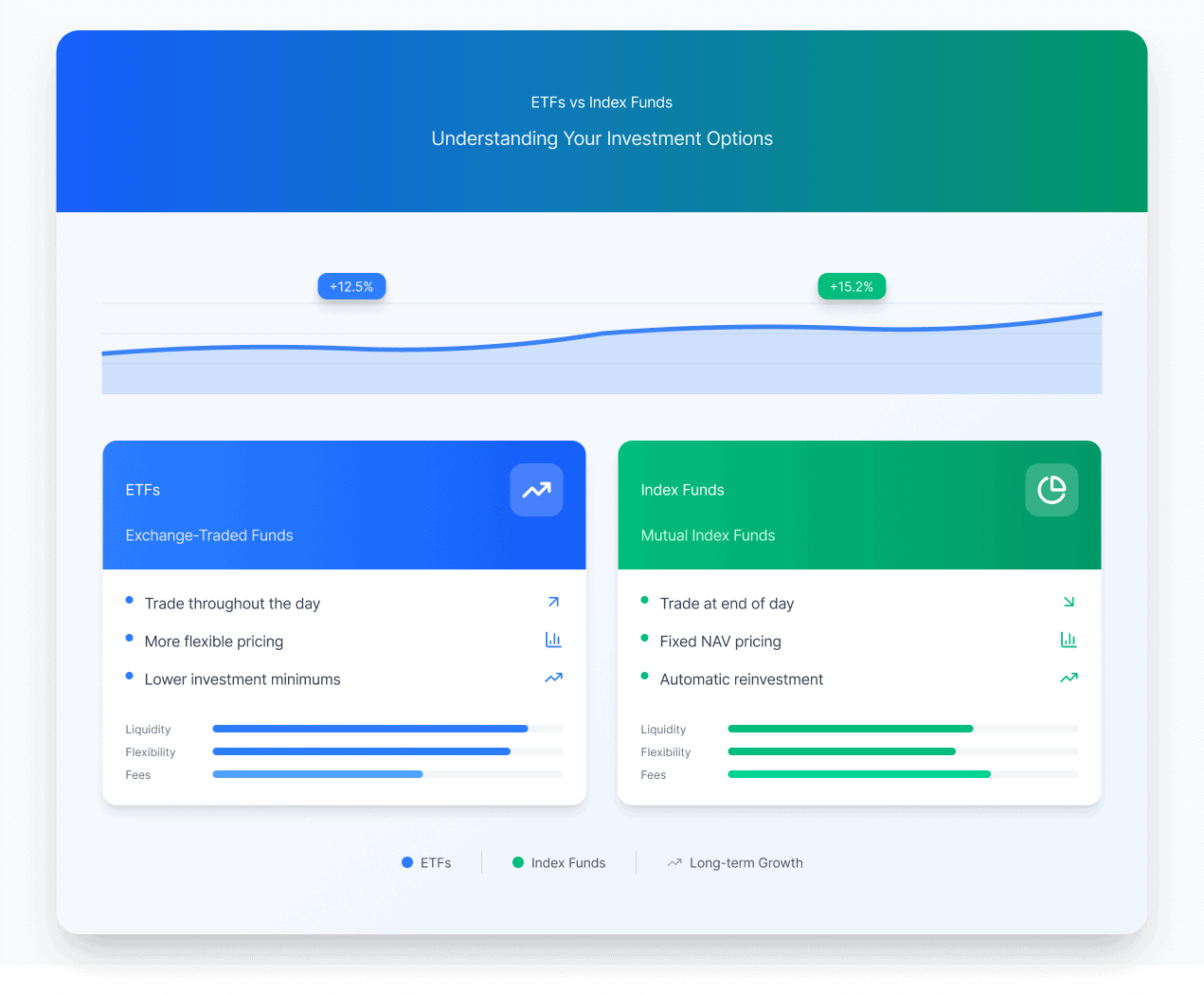
ETFs vs index funds are often presented as two completely different investments. That comparison is slightly misleading: an ETF is a fund structure, while an index fund is a fund that follows an index. An index fund can be structured as either an ETF or a mutual fund.
So the useful comparison for most beginners is an index ETF versus an index mutual fund. Both can offer broad diversification and low costs, but they differ in how you trade, what price you receive, how easily you automate contributions, and which extra costs may apply.
Quick comparison: index ETF vs index mutual fund
| Feature | Index ETF | Index mutual fund |
|---|---|---|
| Trading | Trades throughout the market day | Orders execute once daily after NAV is calculated |
| Price | Market price may be above or below NAV | End-of-day net asset value (NAV) |
| Minimum | Usually one share, or less if fractional shares are available | Depends on the fund provider |
| Automatic investing | Depends on the broker | Often simple to set up in exact dollar amounts |
| Possible extra costs | Bid-ask spread and, at some brokers, commissions | Possible sales loads, transaction or account fees |
| Taxable accounts | Often distributes fewer capital gains, but not guaranteed | May distribute taxable capital gains |
The table is a starting point, not a reason to buy a particular fund. Two funds with the same label can track different indexes, charge different fees, and hold very different investments.
1. “ETF” and “index fund” describe different things
An ETF, or exchange-traded fund, describes how the fund is packaged and traded. Investors buy and sell ETF shares on an exchange. The fund itself may follow an index or may be actively managed.
An index fund describes an investment strategy: it seeks to track a market index. It can be an ETF or a traditional mutual fund. That means some ETFs are index funds, but not every ETF is an index fund. Likewise, not every mutual fund is an index fund.
This distinction matters because the word “ETF” alone tells you little about diversification or risk. A broad-market ETF may own thousands of securities, while a concentrated sector, leveraged, or single-stock ETF can carry much more risk.
2. ETFs trade during the day; mutual funds use end-of-day NAV
You can place an ETF order while the market is open. Its market price changes during the day, just like a stock. You may use market or limit orders, although beginners should understand how each order type works before trading.
An index mutual fund works differently. Whether you enter the order in the morning or shortly before the provider’s cutoff, the transaction generally occurs at the fund’s next calculated net asset value. That is normally calculated after the market closes.
Intraday trading is useful to some investors, but it is not automatically an advantage for long-term investing. If your plan is to invest a fixed amount every payday, the convenience of automation may matter more than seeing a live price.
3. ETF market price can differ from its underlying value
An ETF has both a market price and a net asset value. Supply and demand can cause its market price to trade at a premium or discount to NAV. For widely traded broad-market ETFs, the difference may be small, but it can widen during volatile markets or in less-liquid funds.
ETF investors also face the bid-ask spread: the gap between the highest price a buyer offers and the lowest price a seller accepts. A wider spread is an indirect trading cost. Mutual fund investors do not face a bid-ask spread because transactions occur at NAV, although other fees can apply.
4. Compare total costs, not just the expense ratio
The expense ratio is the annual percentage of fund assets used for operating expenses. For example, a 0.10% expense ratio represents roughly $10 a year for every $10,000 invested, before considering compounding and changes in account value.
A lower expense ratio leaves more of the return in your account, but it is not the only cost. With an ETF, check commissions, bid-ask spreads, and any premium or discount. With a mutual fund, check for sales loads, transaction fees, redemption fees, and account charges. The fund prospectus contains a standardized fee table.
Do not assume that ETFs are always cheaper. Compare the actual funds available through your brokerage or retirement plan. A low-cost index mutual fund can be cheaper for one investor, while an index ETF can be cheaper for another.
5. Minimum investment and fractional shares vary
Traditionally, an ETF required enough cash to buy at least one share, while some mutual funds required an initial minimum. Today, many brokers offer fractional ETF shares, and many mutual funds have low or no minimums. Policies still vary by broker and fund provider.
If you are starting with a small amount, check whether your platform supports fractional shares, automatic purchases, and recurring deposits. Our guide on how much money you need to start investing explains why consistency can matter more than waiting for a large starting balance.
6. Mutual funds can make automatic investing easier
Many index mutual funds let you schedule an exact dollar amount, such as $100 every month. Dividends can usually be reinvested automatically as well. That makes them convenient for a hands-off plan.
Automatic ETF investing is increasingly common, especially at brokers that support recurring fractional-share purchases. It is not universal, however. Before choosing a fund, verify what your specific platform allows rather than relying on a general rule.
7. ETFs may be more tax-efficient in taxable accounts
Because of how ETF shares are commonly created and redeemed, ETFs often make fewer capital-gains distributions than comparable mutual funds. This can be useful in a taxable brokerage account, but it is not a guarantee. Selling ETF shares at a profit can still create a taxable gain, and dividends may be taxable.
Inside a tax-advantaged account such as an IRA or 401(k), the difference in annual capital-gains distributions generally does not provide the same tax benefit. Account rules and personal tax situations vary, so consider qualified tax advice when the amounts are meaningful.
Which is better for a beginner?
An index ETF may fit if your broker offers commission-free and fractional trading, you want access to a specific low-cost fund, or tax efficiency in a taxable account is important to you.
An index mutual fund may fit if you value automatic investing in exact dollar amounts, want every contribution fully invested, or the best low-cost option in your workplace retirement plan is a mutual fund.
For a long-term investor, the structure is often less important than choosing a diversified fund, keeping costs low, contributing regularly, and avoiding emotional trading. Compare the underlying index, holdings, expense ratio, tracking performance, account type, provider, and all trading costs.
A practical checklist before you invest
- Read the fund’s objective and confirm which index it follows.
- Review its largest holdings and sector or country concentration.
- Compare the expense ratio and every platform-level fee.
- For an ETF, check trading volume, spread, and premium or discount information.
- Confirm minimums, fractional-share support, and automatic investment options.
- Consider whether the investment is held in a taxable or tax-advantaged account.
- Make sure the risk level and time horizon match your goal.
The SEC’s Investor.gov resources explain the characteristics of mutual funds and ETFs and provide a detailed guide to fund fees and expenses. Read a fund’s current prospectus before investing.
Frequently asked questions
Is an ETF the same as an index fund?
No. ETF refers to a fund structure that trades on an exchange. Index fund refers to a strategy that tracks an index. An index fund may be an ETF or a mutual fund.
Do ETFs always have lower fees?
No. Compare each fund’s expense ratio plus commissions, spreads, sales charges, transaction fees, and account fees. The cheaper option depends on the funds and platform available to you.
Are ETFs more tax-efficient than index mutual funds?
ETFs often distribute fewer capital gains in taxable accounts, but this is not guaranteed. The advantage generally does not apply in the same way inside an IRA or 401(k).
Can I lose money in an index ETF or index mutual fund?
Yes. Both can fall when the securities they hold lose value. Diversification can reduce some risks, but it does not prevent losses or guarantee returns.
Bottom line
The real ETFs vs index funds decision is usually an index ETF versus an index mutual fund. Neither structure is automatically better. Choose by comparing the actual fund, the account where you will hold it, total costs, tax treatment, and the investing features that help you stay consistent.
This article is for educational purposes and is not personalized investment, tax, or legal advice. All investments involve risk, including possible loss of principal. Past performance does not guarantee future results.
1 thought on “ETFs vs Index Funds: Key Differences for Beginners”